household (**하우**스홀드) — all the people who live together in one house
Part of speech: NOUN
Definition: all the people who live together in one house
Pronunciation (IPA): /ˈhaʊshoʊld/
Korean meaning: 한 집에서 함께 사는 모든 사람들, 가정
Korean pronunciation: **하우**스홀드
Example Sentences
- My grandmother runs the household like a military general commanding her troops.
- The average household spends more on coffee than on books.
- Our household rule is simple: whoever finishes the milk buys the next carton.
household
NOUN[/ˈhaʊshoʊld/]
하우스홀드
all the people who live together in one house
한 집에서 함께 사는 모든 사람들, 가정
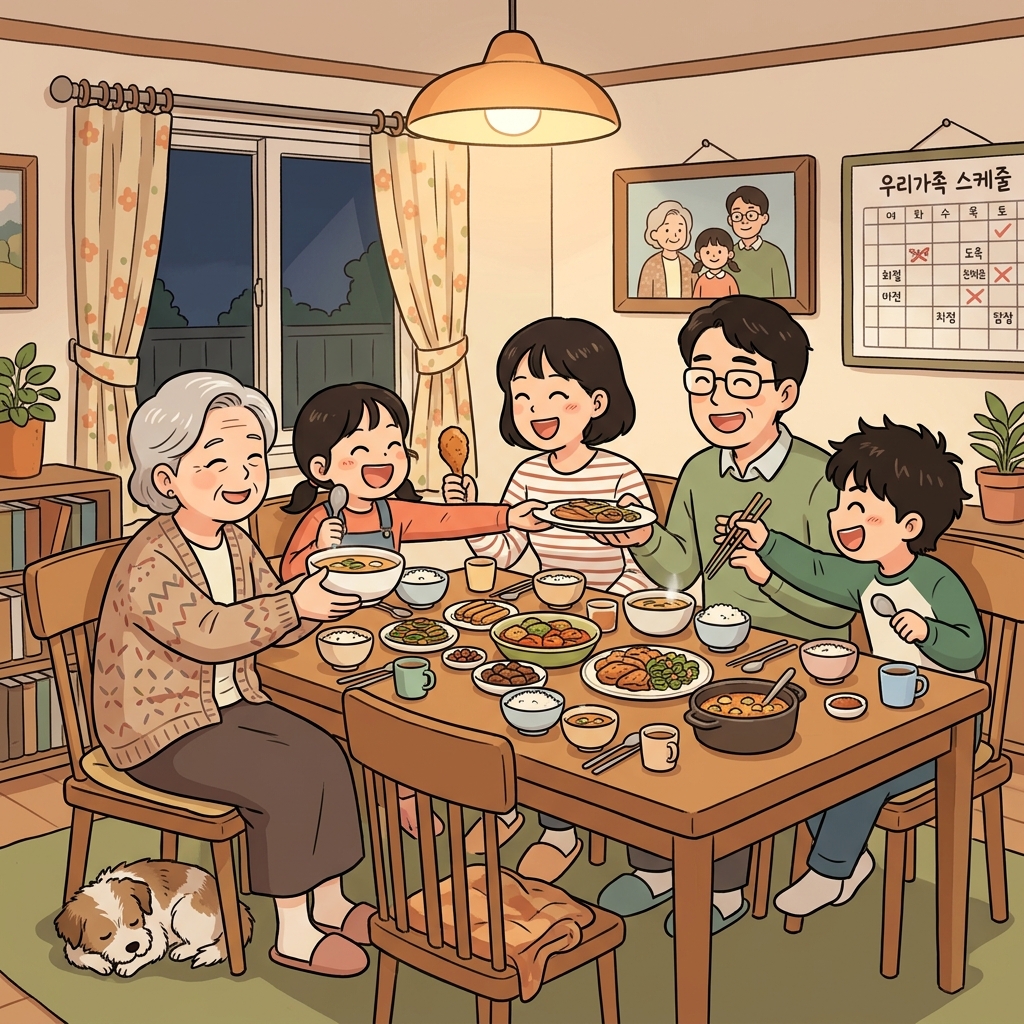
일요일 저녁이면 온 가족이 식탁에 다 모인다.
🎤발음
🌳어원 분석
두 개의 독립적인 단어가 결합된 복합어
기원
14세기 중세 영어에서 시작된 합성어로, 'house(집)'와 'hold(보유하다, 유지하다)'가 합쳐져서 '집을 유지하는 단위'라는 의미로 발전했습니다.
형태소 분해
house + hold = 집을 유지하는 단위
진화 과정
14세기 중세 영어에서 시작된 합성어로, 'house(집)'와 'hold(보유하다, 유지하다)'가 합쳐져서 '집을 유지하는 단위'라는 의미로 발전했습니다.
💡창의적 암기법
AI Generated Mnemonic
'하우스홀드'를 '하우스(집) 홀딩(holding=잡고 있는)' 즉 '집을 잡고 있는 사람들 = 가정'으로 연상하세요. 집을 든든히 잡고 있는 가족들의 모습을 떠올려보세요.
💡 하우스 + 홀딩 = 집을 잡고 있는 가정
🎵라이밍 (Rhyme)
-old 발음으로 끝나는 단어들과 함께 기억하기
-old 발음으로 끝나는 단어들과 함께 기억하기
🔗연어 (Collocation)
집안일
가계 소득
생활용품
가계 예산
가전제품
가정을 꾸려나가다
📝예문
“My grandmother runs the household like a military general commanding her troops.”
우리 할머니는 부대를 지휘하는 장군처럼 가정을 운영하신다.
“The average household spends more on coffee than on books.”
평균적인 가정은 책보다 커피에 더 많은 돈을 쓴다.
“Our household rule is simple: whoever finishes the milk buys the next carton.”
우리 집 규칙은 간단하다: 우유를 다 마신 사람이 다음 우유를 사온다.
“She manages the household finances with impressive efficiency.”
그녀는 인상적인 효율성으로 가계를 관리한다.